 United States
 United Kingdom
 Spain
 Netherlands
 Portugal
 France

How to reduce DSO: a practical plan for B2B AR teams
Reduce DSO with a clear diagnosis, consistent reminders, dispute ownership and a 30/60/90-day plan. Includes a worked example and progress metrics.
To reduce Days Sales Outstanding (DSO), identify why invoices remain unpaid, fix the causes of delay, and make follow-up consistent. Start with accurate invoices and agreed payment terms, assign owners to disputes, and automate repeatable reminders. Measure cash collected, overdue balances, and team workload alongside DSO to see what is improving.
For CFOs, controllers, and accounts receivable managers, a useful DSO reduction plan connects each payment problem to an action, an owner, and a measurable result.
Credit-IQ is business-to-business (B2B) accounts receivable (AR) software from Atradius Collections. It helps teams organize follow-up alongside supported accounting systems through reminder workflows, shared tasks and notes, and an AR overview.
What does DSO measure, and how do you calculate it?
DSO expresses outstanding receivables in days of credit sales. One established method uses the closing receivables balance:
DSO = closing accounts receivable ÷ credit sales for the period × days in the period.
For a business with $600,000 in closing receivables and $3,650,000 in annual credit sales:
$600,000 ÷ $3,650,000 × 365 = 60 days.
Oracle documents this closing-balance method, together with alternative DSO measures. Keep your chosen method, reporting scope, currency, and sales basis consistent.
DSO includes invoices that are still within agreed terms. Read it alongside due dates and overdue aging before deciding where to intervene. Changes in sales, customer mix, credits, and write-offs can also move the ratio.
Diagnose the payment delays before choosing a solution
Start with a sample of overdue accounts and record the reason each invoice remains open. Review the balance, customer response, payment history, and next action. This separates problems your team can fix from amounts that are not yet due or require a credit decision.
The following table is a suggested operating framework. Adapt the owners and measures to your business.

| Reason payment is delayed | First useful action | Responsible team | Measure to review |
|---|---|---|---|
| Invoice missing, rejected, or sent to the wrong contact | Confirm the required purchase order, billing contact, and delivery route; correct and resend | Billing or AR | Invoice rejections and time from billing event to accepted invoice |
| Customer disputes price, delivery, or scope | Record the disputed amount and evidence needed; assign a response date | Named AR, sales, or operations owner | Age of unresolved disputes and amount awaiting resolution |
| Follow-up is inconsistent | Define a reminder sequence and the point for personal review | AR | Overdue accounts with no next action |
| Promised payment has not arrived | Check receipts, contact the customer, and agree the next step | Account owner | Payment commitments met by their agreed date |
| Customer has paid but the invoice remains open | Reconcile the receipt or credit before further chasing | Accounting or cash application | Unallocated receipts and time to reconcile |
| Customer reports difficulty paying | Review the account and available options under your credit policy | Authorized finance or credit lead | Agreed arrangements kept and cash actually received |
Use a specific note such as “purchase order missing; billing to resend by Friday.” That gives colleagues a useful next action and keeps the customer from receiving several uncoordinated messages.

Six practical steps to reduce DSO
1. Make invoices easy to approve and pay
Check the customer's legal entity, agreed amount, purchase order, due date, payment instructions, and billing destination. Send the invoice when the agreed billing event occurs and confirm any required portal submission.
If the same invoice error appears repeatedly, assign the fix to the team that creates or delivers the invoice. Chasing the customer more often will not resolve an invoice that their accounts payable team cannot approve.
2. Align follow-up with the agreed payment terms
Check that the due date in your records matches the agreement. Make sure AR knows about different terms, approved arrangements, and changes agreed by sales.
Set targets that reflect your customer mix and commercial position. Atradius' DSO guidance explains why the right approach depends on the business and its credit terms. Discuss changes for future sales with the relevant commercial owners.
3. Make routine reminders consistent
Define the normal sequence and when a person should review the account. Each reminder should identify the invoice, outstanding amount, due date, payment reference, and a clear reply route.
A useful payment question is:
Could you confirm the scheduled payment date for invoice [invoice number]? If an approval or invoice query is holding it up, please tell us what is needed and who can help resolve it.
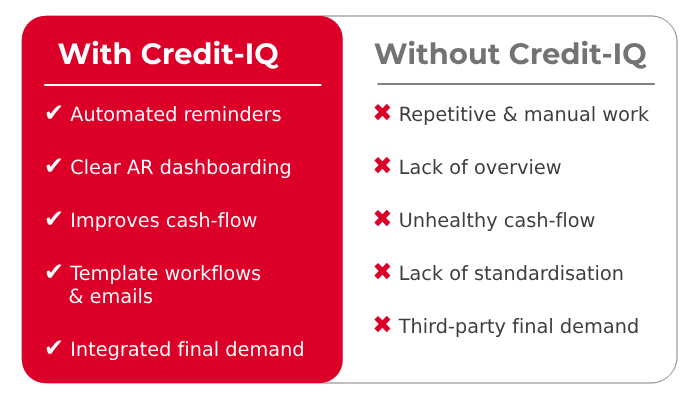
Credit-IQ's automated reminders support templates and customizable workflows. Use them for recurring communication while your team handles replies and exceptions. Before rollout, test how current payment data, disputes, and approved arrangements are handled in your setup.
Resolve exceptions and review progress
4. Give disputes and handoffs a named owner
For each query, record the amount affected, evidence needed, owner, next action, and response date. Bring in sales or operations when they hold the information required to resolve it.
Credit-IQ's centralized tasks and notes help organize responsibility and preserve account context. Agree who contacts the customer while the issue is investigated and how reminders should be handled during that time.
5. Prioritize accounts that need personal attention
Review overdue amount and age together with the reason for delay. A missing document, repeated broken commitment, and customer cash shortage require different responses.
Use the Credit-IQ AR overview to support a review of outstanding accounts. Decide the next action and review date for each priority account. Where normal follow-up has been exhausted, assess the available route to professional debt collection through Atradius Collections, including the account circumstances and applicable service terms.
6. Review the causes of delay as well as the balance
Hold a weekly review focused on decisions: what is blocking payment, who will act, and when the account will be reviewed again?
Feed recurring issues back to billing, sales, and operations. If several customers reject invoices for the same missing reference, correcting that process is more useful than adding another reminder. Track the operational measures below alongside your consistent DSO calculation.
What could a 10-day DSO reduction mean for cash?
At unchanged daily credit sales, a lower DSO corresponds to a lower receivables balance. The relationship follows the receivables forecasting calculation documented by Oracle NetSuite.
Illustrative reduction in receivables = daily credit sales × reduction in DSO.
| Illustrative input or result | Amount |
|---|---|
| Annual credit sales | $3,650,000 |
| Daily credit sales, using 365 days | $10,000 |
| Starting DSO | 60 days |
| Illustrative target DSO | 50 days |
| Reduction in receivables at unchanged daily sales | $100,000 |
$3,650,000 ÷ 365 × 10 = $100,000.
In this scenario, receivables move from $600,000 to $500,000. If the reduction comes from customer payments, it releases cash tied up in existing invoices. It does not create $100,000 of additional revenue or profit.
This is a worked example, not a customer result or a promised Credit-IQ outcome. Keep the sales base and accounting treatment consistent, and reconcile the movement to actual collections.
A lower DSO does not always mean more cash
Compare three simplified changes from the same starting point: $600,000 in gross open trade receivables and $10,000 in daily credit sales, giving a DSO of 60 days.
| Change from the baseline | Gross open receivables | Credit sales per day | DSO | Cash collected from the stated change |
|---|---|---|---|---|
| Collect $100,000 from customers | $500,000 | $10,000 | 50 days | $100,000 |
| Write off $100,000 from the gross open balance | $500,000 | $10,000 | 50 days | $0 |
| Daily credit sales rise; the closing balance stays unchanged | $600,000 | $12,000 | 50 days | $0 from the sales-denominator change alone |
Each row changes only the stated input. These are analytical examples, not customer results or forecasts of a full accounting period. The write-off example uses gross open receivables before allowances; a net-of-allowance measure can behave differently.
The same 50-day headline can therefore describe different events. Reconcile customer receipts, new invoices, credits, write-offs, and the sales denominator before attributing a change to better collections.

Build a 30/60/90-day DSO improvement plan
Use the first month to establish a baseline and test a focused workflow. Use the next two months to review results across payment cycles and expand the changes that work.
The schedule below is a suggested improvement process. It does not predict when a particular DSO reduction will occur.
| Period | Main work | Evidence to keep |
|---|---|---|
| Days 1–30: diagnose and test | Confirm the calculation and account data; identify recurring delays; agree owners and reminder rules; pilot a selected group of accounts | Starting DSO and aging, reasons for delay, assigned actions, customer responses, and cash received |
| Days 31–60: evaluate and refine | Review missed commitments and unresolved disputes; correct recurring invoice issues; adjust the pilot workflow | Results by account group, outstanding issues, reconciliation changes, and time spent on follow-up |
| Days 61–90: expand and standardize | Apply useful changes to comparable accounts; document handoffs; agree a regular management review | Consistent reporting periods, cash collected, overdue balances, workload, and any changes in sales or terms |
For the first 30 days, spend week one checking the baseline, week two defining actions and ownership, week three testing the process, and week four reviewing what happened.
Compare accounts with similar terms and starting invoice ages. Record changes in sales, customer mix, credits, and write-offs. A before-and-after improvement is useful evidence, but it does not by itself show which change caused the result.
How should you measure progress?
Track DSO with a small set of operational measures. Each should have a clear definition, matching reporting period, and source.
- DSO: use your agreed receivables-to-credit-sales calculation to track the balance relative to sales.
- Overdue share: divide overdue invoice balances by total open invoice balances on the same reporting date.
- Cash collected from pilot accounts: track customer receipts allocated to the defined pilot invoices in the reporting period.
- Unresolved dispute age: report days since each still-open dispute was recorded, grouped by age band.
- Payment commitments kept: divide commitments paid by their agreed date by commitments due for review in the period.
- Routine follow-up time: record time spent on reminders and handoffs for a defined workload.
Keep zero activity separate from missing information. For example, a payment-commitment rate is unavailable when no commitments fall due for review.
DSO can improve when receivables are written off or sales rise, even without better collections. Review cash received and the movement in receivables before attributing a lower ratio to automation.

When can AR automation help reduce DSO?
AR automation is worth evaluating when recurring reminders consume team time, follow-up is inconsistent, or account context is spread across inboxes. The value to test is a more repeatable process with clearer responsibility and less manual repetition.
Credit-IQ brings reminder workflows, shared tasks and notes, and an AR overview together. It works alongside supported accounting systems. Your finance team still needs to resolve invoice errors, make credit decisions, and manage customer exceptions.
Before choosing a tool, check:
- Accounting fit: review the available integrations for your exact package and edition. Confirm the data covered, update process, and implementation requirements.
- Workflow controls: ask how your team handles an already-paid invoice, a dispute, or an agreed payment arrangement.
- Team responsibilities: test task assignment, account notes, and handoffs using a real example.
- Total cost: review current US plans, invoice limits, and relevant synchronization fees. Debt collection services have separate terms and charges.
- Required scope: include payment processing, cash application, or other functions explicitly if your team needs them. Do not assume every AR tool covers the same work.
For a broader buying evaluation, compare the accounts receivable software options against the bottlenecks identified in your own process.
Check these exceptions before automating reminders
Use a small test set before applying a workflow more widely. Confirm the outcome in your actual setup, including any manual review needed.
- Already-paid invoice: record a payment in the accounting source, check when the balance updates, and verify that your team prevents an incorrect overdue reminder.
- Partially paid or credited invoice: compare the remaining balance and currency with the proposed message before it is sent.
- Disputed invoice or payment arrangement: assign an owner, record the next review date, and check how communication is controlled while the exception is open.
These are acceptance tests for your process. They do not assume that every connector or workflow automatically pauses, reconciles, or resolves an exception.

Test your receivables follow-up workflow
See how Credit-IQ can help your team organize reminders, tasks, and overdue account follow-up. Explore a free software trial.
Frequently asked questions
What is a good DSO target?
Set a target against your agreed payment terms, customer mix, and a consistent baseline. Review overdue balances to distinguish amounts still within their terms from delays your team can address. A universal target can hide important differences between businesses.
How can we reduce DSO without adding headcount?
Start by removing repeat work: correct recurring invoice errors, standardize reminders, and keep ownership and account notes in one shared process. Measure time spent on routine follow-up alongside cash collected. Use the capacity released to handle exceptions and priority accounts.
How quickly can AR automation improve DSO?
Timing depends on payment terms, the causes of delay, and when customers actually pay. A 30-day pilot can test the workflow and reveal operational changes. Review DSO across consistent periods and continue tracking accounts through their payment cycles.
Should we track CEI as well as DSO?
CEI evaluates collection effectiveness over a period, while DSO expresses receivables in days of sales. They answer different questions. If your team uses CEI, apply a consistent definition; Oracle documents the Collections Effectiveness Index calculation. Neither measure replaces a review of disputes, overdue aging, and cash received.
Does Credit-IQ automatically calculate DSO or resolve disputes?
Use your finance team's agreed DSO calculation. Credit-IQ's public feature pages describe reminders, tasks and notes, and receivables visibility; confirm any DSO reporting and dispute controls required for your setup during evaluation. Assign people to resolve customer queries and approve exceptions.
Discuss your AR workflow with Credit-IQ
Bring your accounting package and edition, a typical overdue account, and one recurring invoice query. Ask how reminders, tasks, account information, and escalation would work for your team.
Contact Credit-IQ to discuss your AR workflow and request a demonstration focused on those requirements.